
Showing posts with label Family Resource Programs/ Centre de ressources. Show all posts
Showing posts with label Family Resource Programs/ Centre de ressources. Show all posts
Friday, June 28, 2013


Thursday, April 25, 2013
Mise à jour: Nos arbres de succès
Au mois de
janvier, j’ai fait part du fait que nous avions été inspirés à créer des arbres
de succès pour chacun de nos sites de groupes de jeu après avoir lu un message
sur le blogue. (suivre ce lien pour lire le message — janvier 2013)
Malheureusement,
nos arbres étaient un peu nus! Que faire pour encourager les parents et les
responsables de garde à noter et afficher des observations de leurs enfants?
Une de nos
intervenantes à l’appui a suggéré d’inviter les adultes à l’heure du cercle à
écrire une petite observation et à l’afficher sur l’arbre. Ce fut un grand
succès! Lorsque les adultes ajoutaient leurs observations, l’intervenante
lisait les messages à haute voix afin d’encourager les enfants et rehausser
leur estime de soi.
Une fois
que l’arbre bourgeonnait d’observations, les parents et les responsables de garde
semblaient plus à l’aise d’ajouter leurs observations sans incitation.
La persistance
et la résolution de problèmes sont des compétences de base qui sont aussi
importantes pour les adultes que pour les enfants!
 |
| Arbre de succès au groupe de jeu Marius Barbeau |
Update on the success trees at OEYC Ottawa South
In January, I shared that we were inspired by a post on the blog to create success trees at each of our drop-in program sites. (January 2013 post about Success Tree)
In many of our groups, the trees didn't seem to be "taking off" but we really believed in the concept of having parents/guardians and caregivers engaged and involved in observing their child's development and learning.
Time to come up with a strategy! One of our support workers suggested that we invite the adults at circle time to come up to the tree and write something that they have observed their child doing recently.
It worked really well! They wrote their observation and added it to the tree while the playgroup facilitator read them aloud to validate children's successes.
Once those observations were up, parents and caregivers seemed more at ease to add new successes as they observed them.
In many of our groups, the trees didn't seem to be "taking off" but we really believed in the concept of having parents/guardians and caregivers engaged and involved in observing their child's development and learning.
Time to come up with a strategy! One of our support workers suggested that we invite the adults at circle time to come up to the tree and write something that they have observed their child doing recently.
It worked really well! They wrote their observation and added it to the tree while the playgroup facilitator read them aloud to validate children's successes.
Once those observations were up, parents and caregivers seemed more at ease to add new successes as they observed them.
Persistence and problem solving are root skills that are as valuable to educators as they are to children in our programs!
 |
| Success Tree at Marius Barbeau francophone playgroup |
Thursday, March 28, 2013

Let's Talk Principles...
Leona Patlik
Monique Collin
Monique Lanthier
Early Literacy Specialists
Parent Resource Centre
In our work as Early Literacy Specialists,
my colleagues and I are often faced with the challenge of finding ways to
interpret concepts so they can be applied rapidly to the childcare settings in
our community. It’s no secret that we champion the “Early Learning for Every
Child Today” (ELECT) framework and our work over the last 2 years focused
mainly on training professionals to make the most of the interactions they had
with the children and families in their care. And although most of our
workshops and conference presentations usually end with us handing over
resources and strategies our participants can use right away, there are some
concepts in the framework that are more difficult to convey.
Our greatest challenge so far
has been to demystify the 6 statements of principles, which are designed to
guide our work in early childhood development. They can be interpreted in many
different ways, an as with most of the information contained in the ELECT
document, there is no true right or wrong way of interpreting them. It takes
time and reflection to figure out how to apply them to any childcare setting.
There is no way to demystify the
statements in a short article such as this one. However, it is a perfect forum
for us to begin discussions and this article will contain very simple interpretations, insights and suggestions.
Statement of Principle
1: Early child development sets the foundation for lifelong learning, behaviour
and health.
Adults who were exposed to many
new learning experiences as children deal better with stress and adapt well to
change.
When young children are given
many learning opportunities, they tend to adapt well to change as they grow up.
While children need structure and routine, they also need to have new
experiences in a safe environment, with adults they trust. The confidence and
self-esteem they build when they have been able to solve problems, work with others,
make friends and successfully complete tasks on their own helps them approach
new experiences and new environments with more ease. Don’t be afraid to give
children new materials to work with or make changes to their learning
environment. Just make sure you are respectful of their emotions and respond
accordingly. The goal here is to help children successfully face new
challenges, not to avoid new experiences altogether.
Statement of Principle
2: Partnerships with families and communities strengthen the ability of early
childhood settings to meet the needs of young children.
Learning to socialize,
collaborate and cooperate are essential life skills that lead to creating
strong, prosperous communities.
Much of the partnerships in
early childhood involve organizations in the related sectors. But they don’t
have to be. There are many members of the community who are more than happy to
contribute to the health and well being of our children. And contributing
doesn’t always need to mean giving money. My colleagues and I seek out partnerships
as a way to make projects happen much faster and with very little money. We
have asked businesses in our community to contribute materials for events, such
as panels for a Book Walk that would have been too expensive to purchase.
But there is more to
partnerships than exchanging money or materials: there is a social aspect. As
we use more and more technology to communicate quickly, basic social skills in
our society have begun to suffer. The experience of bringing people together
for a common goal is a great way to teach children about how they fit in their
community.
There’s no doubt that we all
want the best for our youth, but how will they learn to reach out to their
community if we don’t teach them how? Try coming up with an event that would
require you to ask merchants in your neighbourhood to contribute anything but
money (time, space, materials, etc.). Have the children and families contribute
as well so they see what a community partnership looks like and what it can
lead to.
Statement of Principle
3: Demonstration of respect for diversity, equity and inclusion are
prerequisites for optimal development and learning.
Children develop a strong sense
of self from growing up in an environment that supports and respects their
individuality.
We talk quite a bit about
multiculturalism and inclusion in our society, but diversity is more than just
making sure you have dolls and posters that reflect different cultures. At the
very root, diversity is about open minds, self-esteem and tolerance for all
points of view. The objective in this principle is to view each child (and
adult) as a unique person.
This is difficult because we
tend to believe that treating everyone as unique is more work, or that it’s not
fair to not treat everyone the same. Just because one child needs more, it
certainly doesn’t mean we are neglecting the child who doesn’t. So let’s
redefine the word, “fair” to mean “every child’s needs are met.” Get to know
your families, go beyond just learning their names and their cultures.
Statement of Principle
4: A planned curriculum supports early learning.
Planning focuses on learning
goals determined by assessing children’s developmental needs.
The idea behind this principle
is that the planning process involves thinking about what you have observed the
children doing, learning and struggling with. It involves thinking about the
space and materials at your disposal and how you might use them. The process
also helps you determine how you will support children’s skills development. Without
proper planning, curriculum becomes rigid and inflexible because not enough
thought has been put into what’s really important. It may sound like a
contradiction, but the truth is a planned curriculum gives you more flexibility
in your work, not to mention, it helps you make better use of your time.
Planning in advance requires
that you set appropriate learning goals for the children and think about the many
ways they can be achieved. Think of ways to include skills development in
subjects children are interested in or their favourite games.
Statement of Principle
5: Play is a means to early learning that capitalizes on children’s natural
curiosity and exuberance.
Play is highly motivated
practice.
There is much learning going on
when children are at play, from cognitive problem-solving to social
interactions and vocabulary development. It’s not that having fun makes
children learn more effectively, it’s that the children are more readily open
to acquiring new skills if they are embedded in a quality play experience. They
will put more effort into learning a game they are interested in playing than
in learning “boring grownup stuff” that usually requires them to sit quietly
and listen.
Watching children during free
play is a perfect opportunity to assess where they are situated on their
continuum of development. In fact, it’s one of the best assessment tools you
have at your disposal, since it shows how children naturally apply their
understanding of concepts, behaviours and interactions to their environment.
How much, or how little, you participate in their play experiences will depend
on what you are trying to observe or what skill you are trying to develop.
Statement of Principle
6: Knowledgeable and responsive early childhood practitioners are essential to
early childhood settings.
Reflective early childhood
professionals are better prepared to respond to the needs of their families.
There is a direct relationship
between self-reflection and quality of service. Reflecting upon your
environment, having discussions with families, thinking about your prior
experiences and observations is necessary to help you to make decisions about the
best way to approach your work. The discomfort that comes with self-reflection usually
has to do with the idea that if we self-reflect, we are looking for something
we are doing wrong. Although it is important to be honest with yourself, the
objective of the process is not necessarily to find fault: it’s an effort to
improve. For example, the decision to take a workshop doesn’t mean you lack
professional skills, it simply means you wish to add to the ones you have. And
you would have determined this after having reflected on how to better meet the
needs of your families.
Hopefully this will give you
cause to think about the principles and how they apply to your specific reality.
Thursday, January 31, 2013
A week filled with activities at the OEYC Ottawa South to celebrate Family Literacy Day 2013
By Julie Cloutier, Early Years Educator
This year at the Early Years Centre Ottawa South we wanted to involve our families a little more in ways of raising awareness of the importance of reading and engaging in other literacy-related activities.
To celebrate the importance of literacy, we asked parents/guardians/caregivers to share their favourite book or song during circle time throughout the week. Staff also made posters of their favourite book which were posted in their playgroups and we placed "Literacy Caterpillars" at each of our sites to give everyone, big and small, the opportunity to highlight their favourite book! Our caterpillars are growing every day!


Families and caregivers attending playgroup had the chance to enter their names for several book draws. For our Daddy and Me playgroup we invited a special guest to play guitar and co-animate circle time.
Families had the opportunity to sign up for our Little Book Worms: I Love Books! workshop. In this workshop, families shared in the magic of books by doing different activities related to the book "Chicka Chicka Boom Boom". Children made letters out of playdough, used magnetic letters to act out the story and wrote and illustrated their own books.


In addition to these activities, programming in some of the playgroup locations was done to reflect on literacy.At our French playgroup, Marius Barbeau, the art table was set up for children to make their own books and an "invitation to learning" was set out on the cognitive table which included a colour sorting activity, manipulatives as well as books so children could relate what they see in books to their play.


At our Don Reid location, the sensory bin was filled with alphabet sponges. The children could enjoy looking for the letters of their name!
At Hunt Club Riverside, the children were able to enjoy the book "Here's the chick, Where's the chick?" and try to recognize the different sounds of the animals in the book. There was also linking letter monkeys at the manipulative table for children to practice their alphabet, recognize different letters and increase their fine motor skills by linking the monkeys together!
Une semaine remplie d’activités au CPE Ottawa Sud pour souligner la journée de l’alphabétisation
Par Julie Cloutier, Intervenante ressource à la petite enfance, Centre de la petite enfance Ottawa Sud
Cette année, au Centre de la petite enfance (CPE) Ottawa-Sud, nous voulions sensibiliser nos familles à l'importance de la lecture et les impliquer dans d'autres activités liées à l'alphabétisation.
Pour célébrer la journée de l'alphabétisation, nous avons fait une demande à nos parents/tuteurs et responsables de garde de partager un livre ou une chanson préférée pendant le temps du cercle. Aussi, chaque membre du personnel du CPE a créé une affiche mettant en vedette leur livre préféré qu'elles ont affiché dans nos groupes de jeu. Nous avons aussi placé des « chenilles d'alphabétisation » à tous nos sites pour donner à chacun, petits et grands, l'occasion de souligner leur livre préféré! Nos chenilles grandissent chaque jour!

Les familles et les responsables de garde qui ont participé aux groupes de jeu pendant la semaine ont eu la chance de soumettre un billet par visite au groupe de jeu pour gagner un prix de livres.
Pour notre groupe de jeu « Papa et moi », nous avons eu un invité spécial qui a joué de la guitare et qui a animé le temps du cercle.
Les familles ont également eu l'occasion de s'inscrire à notre atelier Little Book Worms: I Love Books! Dans cet atelier, les parents et les enfants ont partagé la magie des livres en participant à différentes activités reliées au livre « Chicka Chicka Boom Boom". Les enfants ont conçu des lettres en pâte à modeler, utilisé des lettres magnétiques pour réanimer l'histoire et fabriqué leurs propres livres (avec l'aide de maman ou papa !)
À notre groupe de jeu francophone à Marius Barbeau, les enfants ont créé leurs propres livres à la table d'art. Il y avait aussi une « invitation à l'apprentissage » à la table cognitive avec une activité de triage de couleurs, du matériel de manipulation et des livres au sujet des couleurs. Ceci permet aux enfants de lier ce qu'ils voient dans les livres à leur jeu.
Pour notre groupe de jeu à Don Reid, le bac sensoriel était rempli d'éponges en forme d'alphabet. Les enfants pouvaient chercher pour les lettres de leur nom!
À Hunt Club Riverside, les enfants ont lu le livre « Here's the chick, Where's the chick ? » et ils ont essayé de reconnaître les différents sons des animaux du livre. Il y avait aussi un jeu d'alphabet en forme de petits singes qui pouvaient être assemblés à la table de manipulation afin que les enfants puissent pratiquer leur alphabet, reconnaître les différentes lettres et pratiquer leur fine motricité.
Thursday, January 10, 2013
L'inspiration qui nous pousse
Au mois de septembre, Krystal Faubert du Centre de santé communautaire Pinecrest-Queensway a écrit un message au sujet de leur arbre de succès qui est utilisé dans leurs programmes pour encourager la prise de notes par les parents, les responsables de garde et les intervenantes.
Vu que c'est souvent un défi de faire des observations dans nos groupes de jeu car le groupe n'est jamais pareil, nous avons décider de fabriquer nos propres arbres de succès. Nous espèrons que cette stratégie piquera la curiosité et l'intérêt des parents et des responsables de garde afin qu'ils et elles participent à l'observation des habiletés et des intérêts des enfants.

Nous allons vous garder au courant des résultats!
Vu que c'est souvent un défi de faire des observations dans nos groupes de jeu car le groupe n'est jamais pareil, nous avons décider de fabriquer nos propres arbres de succès. Nous espèrons que cette stratégie piquera la curiosité et l'intérêt des parents et des responsables de garde afin qu'ils et elles participent à l'observation des habiletés et des intérêts des enfants.

Nous allons vous garder au courant des résultats!
Inspired by others on the blog!
In September, Krystal Faubert at Pinecrest Queensway Community Health Centre posted a message about the Achievement/Success Trees that they are using to encourage parents, caregivers and parent support workers to jot down their observations of children.
Here, at the OEYC Ottawa South, we loved the idea so much that we were inspired to put together our own. It is always a challenge to capture observations in a drop-in playgroup since the group is never exactly the same! We hope these trees will help pique the interest of parents and caregivers and get them participating in the observation process.
|
| Our large Success Tree at Don Reid (the main location of OEYC Ottawa South) |
We will let you know how it goes!
Arabic Language Drop-in and ELECT
Written by Faiza Bassiseau, Pinecrest Queensway CHC
As a Family Resource Facilitator in the Circle of Support program at Pinecrest Queensway Community Health Centre, I run an Arabic language playgroup for Arabic speaking parents and their children. The principles of ELECT are discussed with families in their first language to give them a deeper understanding. The principles are then linked to the continuum of development to provide high quality and culturally sensitive programming.
The principles that stand out for my group are:
· ELECT principle # 3: “Respect for diversity, equity and inclusion are prerequisites for honoring children’s rights, optimal development and learning”; and
· ELECT principle #2: “Partnerships with families and communities strengthen the ability of early childhood settings to meet the needs of young children.
Following these principles, these are some of the ways that I integrate the concepts of respect for diversity and partnerships:
v At circle time we sing English songs in Arabic using the same rhyme and tune. This allows the families to maintain their language but it also is a path towards integration into the mainstream in that they can identify with the tunes of common children’s songs.
v Much needed support and direction for play based learning is provided in Arabic using the ELECT framework and “language/terminology” (e.g. continuum of development).
v I encourage families to use their home language when interacting with their children and to play with their children to meet their needs.
v Our centre has a “bragging tree” where parents are encouraged to make observations of their children and to post them. Parents in all groups (Arabic and non-Arabic) are encouraged to post in their language. English translations are made later. The children are told that the translations are there so that families in other programs can see and share what is happening in the Arabic group and vice versa. The intention is for the children to gain an understanding that there are other groups and we can all connect together in one activity. This helps in educating children about respect for diversity, equity and inclusion.
Thursday, December 20, 2012
Winter Wonderland - Observations of a Different Nature?
How do you plan curriculum based on observation and documentation when you run drop-in programs? That is a question that our OEYC constantly revisits. We do have our regulars, but with 18 drop-ins per week in 6 locations, the only consistency is change.
The other day I was talking with a couple of staff and we were trying to come up with a great idea for our resource area at our main site. The space is large, but our clients tend to see it as a grown-up space, thanks to the bookshelves around the perimeter. I threw out the idea of turning it into a winter wonderland, complete with a white sheet for snow (the area is carpeted so no slipping), and boxes painted white to build forts and snowmen.
 Now I like to challenge my staff with ideas like “no crafts planned for 3 months-just art” so my staff like to challenge me right back when they can. Once I proposed this idea, one person smiled wryly and asked “Why would you pick winter wonderland? Don’t you think that sounds like a theme?”
She was right in the sense that I did not base this idea on my observations and documentation of the children in the drop-in. Rather, I based it on a presentation recently made at my agency by a Program Effectiveness Data Analysis Coordinator (PEDAC) and patterns of attendance at our drop-ins over the years. Knowing that the community we serve has:
· a higher than average population of New Canadians (many of whom come from climates warmer than Canada);
· a higher than average population of people living in apartments;
· children who score lower on physical health and well being (mostly in the category of gross motor skills) on the EDI; and
· families who venture out less frequently as soon as the weather gets cold
I think it is programming based on observation and documentation. The only difference is that this is a more global approach.
Having a winter wonderland allows the children to use gross motor skills during play and hopefully they will transfer the indoor play to outdoor play once the freezing ran ends and the snow starts to accumulate!
As an OEYC with parents in attendance who play alongside with their children, I also have an ulterior motive and that is for the parents to see how fun it can be to take the kids outside and let them play in the snow. For families living in apartments, playing outside is very important to help their children develop those gross motor skills and to promote overall physical health and well being.

How has the winter wonderland been received? Well, we knew the children would love it, but we didn’t anticipate the parents becoming so involved in the play with their children. We even had one mom on her cell phone calling her friend to come quick to the playroom because they were having a snowball fight. We swear no one has poke out an eyeball… yet!
So when faced with the challenge of how to observe and document in an OEYC/PFLC, all I can say is that sometimes you just have to think globally and act locally!

Friday, November 30, 2012
Get Connected
posted by: Cathy Renouf, Parent Support Worker at the OEYC Ottawa West Nepean
In the infant/Crawler group at the Ottawa West- Nepean OEYC one of our main objectives is the importance of attachment and how ELECT can help promote attachment through the social domain.
Attachment is the deep emotional tie or connection that an infant forms with a main caregiver that binds them together and endures over time.
Here are a few examples on how attachment is promoted in the drop-in.
Parents are asked:
· To leave their car seats in the car and carry their child or use a snuggly or wrap. The more the baby is held close to the caregiver, the child will feel more secure;
· To hold their baby in their arms so they are facing each other;
· Responds to their baby’s cues;
· Comfort their baby when he/she needs it, especially when he/she is hurt sick or frightened;
· Play “copy me “games (this supports observation and imitation, as a way of learning);
· Imitate their child’s expressions and sounds;
· Talk to their child in a calm and gentle voice;
· Sing songs they remember as a child and songs that include their child’s name. (encourages name recognition); and
· Play simple one-to-one games
One example of a one-to-one game is “peek-a-boo” and here is the explanation directly from the ELECT document:
Parents were asked to place a transparent scarf over their child’s face. After a brief pause, pull it off and say “peek-a-boo!”
Eventually some of the babies will attempt to pull of the scarves themselves.
The focus of attachment is on a parent’s responsiveness to their child’s needs and close physical contact between a baby and his parents. Using the above simple tools can make a big difference in the bonding process. Parents already have the ability to achieve this experience. We as professionals need to provide them with the encouragement and criteria through the ELECT process.
Monday, October 29, 2012
Reviewing Principle 2 of ELECT
As you may remember, at the OEYC Ottawa South, we are in the process of reviewing the principles of ELECT at our monthly team meetings. At our next meeting this week, we are going to be taking a look at the second principle of ELECT:
Partnerships
with families and communities help early childhood settings to best meet the
needs of young children.
In order to get the discussion going, we once again used the Ministry of Education site as a resource. All members of the team have looked at the videos and were sent several questions pulled from the text on the site.
We will be asking the following questions:
Do we:
- Maintain a positive,
welcoming climate, where all family perspectives are encouraged, valued
and heard?
- Arrange the physical
environment so that family members are comfortable and “at home” (e.g.
display photos of children, provide books and materials representing
children's culture and first language)?
- Discuss how child's
play demonstrates learning and development, and share ways that this
learning can be extended at home?
- Support families with
parenting challenges, working through situations together?
- Describe our planning
process to families, and encourage their suggestions and involvement?
- Connect families with
each other and with community partners, to help create supportive social
networks?
Wednesday, October 24, 2012
Positive attitudes towards learning

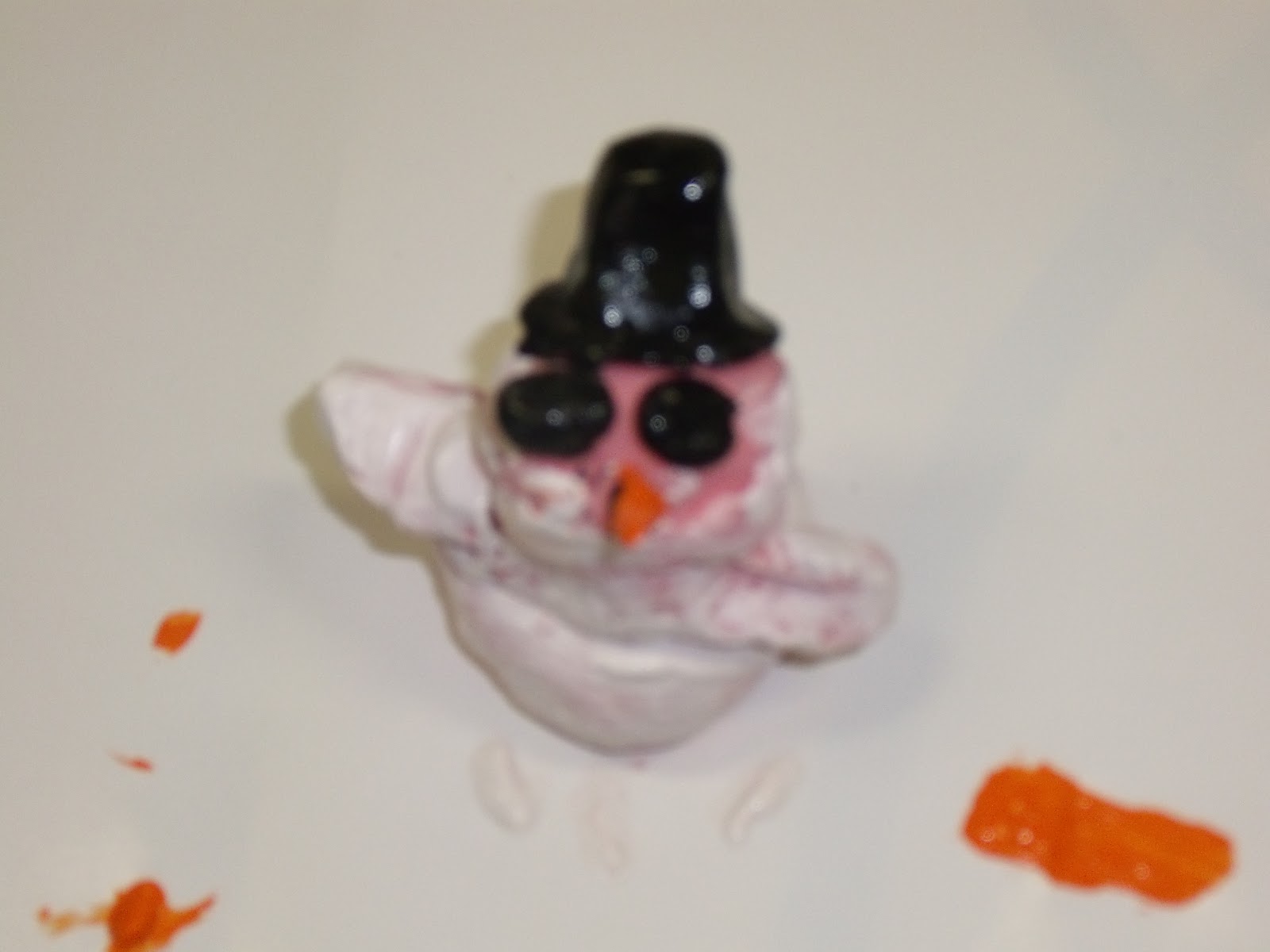 When making a snowman at the play dough table, this 4 year old boy expresses that snowmen are not pink. He verbalizes that he would like to make his snowman white. His mother asks him how he would go about doing that. He pauses to think about it and replies that he could use white paint. Together, we find some white paint and a few paint brushes. After he paints the snowman white, he realizes that the nose and top hat are not the colours he wants them to be. Again, together we collect the paint colours that he would like to apply. He notices that the carrot nose is much smaller than the snowman's body and searches for a smaller brush. The nose fell off several times, but he perservered, with his mother's help and they discovered a way to attach it. The child was very proud of his accomplishment and inspired another child to make his own snowman. He even shared his strategy for keeping the carrot nose on.The mother was pleasantly surprised with the focus and determination he used during the activity.
Learning through play at the PFLC

Implementing ELECT at the PFLC's
At the Parenting and Family Literacy Centres, our intentional
programming focuses on highlighting and practicing the Guiding Principles as
well as the introduction and implementation of the vocabulary of ELECT.
We are fortunate to have the parents and primary caregivers
with us during the program, often for several hours at a time, allowing for
meaningful conversation in real time. We recognize that verbal exchanges work
best for our communities. Parents and caregivers are much more willing to
participate in the all aspects of the program if they feel they are a valued
partner.
We welcome many families from our communities including many
new Canadians and ESL families. We have found that too much posted text can be
overwhelming for all and have decided as a group to implement ELECT strategically
in the following ways:
1) Through
photo albums placed within the classroom. This allows discussions between all
participants in all languages and direct conversation. It also allows for us to
compare and describe the continuum of development in the moment with the parent
or the caregiver. For example, “Do you remember when we took this picture she
would take a toy away from another child when she wanted to play with it, now
she asking for a turn. She is developing her social skills”.
2) Picture
walls that include a learning activity and some corresponding ELECT information.
3) Modified
ELECT booklet for participant use. We have included the introduction, the
guiding principles and the continuum of development to optimize viewing.
4) Learning
Stories on tables and inserted into our modified ELECT binders to illustrate an
example.
5) Discussion
during circle time allowing for explanation of skill indicators. For example,
after finishing a story, pose questions to challenge recall skills. Let the
adults know that this type of questioning increases memory capacity.
6) Recording
observations and engaging in verbal discussions throughout the day.
Note: this is a compilation of all PFLC site strategies.
Each facilitator determines how her site will implement ELECT based on the
needs of the community.
Friday, September 28, 2012
Apprendre par le jeu à la maison
Voici un
bel exemple de l’apprentissage par le jeu à la maison. L’écriture sur le clip est en anglais, mais
vous pouvez observer un père qui décide d’aider son fils à faire voyager son
petit ami ‘’ Thomas le train’’ dans l’espace….
Partir de l’intérêt de l’enfant pour approfondir l’apprentissage c’est merveilleux!
Learning Through Play At Home
This is a beautiful example of learning through play at home. Starting with the interest of a child to expand their learning... it's a wonderful thing!
http://gatineau.radionrj.ca/Video-Buzz/story.aspx?ID=1780318
http://gatineau.radionrj.ca/Video-Buzz/story.aspx?ID=1780318
Engagement familial
Voici une
suggestion très simple pour engager vos familles et les encourager à participer
dans l’apprentissage de leurs enfants.
Placer un grand tableau et de la craie à l’entrée de votre agence, votre
garderie, votre milieu familial ou n’importe lieu ou vos familles
circulent. En grandes lettres écrivez ce
qui suit : Mon enfant s’intéresse à… Ajouter quelques commentaires pour inciter la participation et vous
observerez quelque chose de magnifique, l’engagement
familial (énoncé de principe # 2; Les
partenariats avec les familles et les communautés renforcent la capacité des
milieux de la petite enfance de répondre aux besoins des jeunes enfants). Utiliser les suggestions de vos familles comme
point de départ pour la création d’une programmation vraiment centrée aux
intérêts des enfants. Cette activité vous permet d’engager les familles et les
inciter à porter attention aux intérêts de leur enfant.
Subscribe to:
Posts (Atom)