Showing posts with label Photos. Show all posts

Thursday, April 25, 2013

Mise à jour: Nos arbres de succès


Au mois de janvier, j’ai fait part du fait que nous avions été inspirés à créer des arbres de succès pour chacun de nos sites de groupes de jeu après avoir lu un message sur le blogue. (suivre ce lien pour lire le message — janvier 2013)

Malheureusement, nos arbres étaient un peu nus! Que faire pour encourager les parents et les responsables de garde à noter et afficher des observations de leurs enfants?

Une de nos intervenantes à l’appui a suggéré d’inviter les adultes à l’heure du cercle à écrire une petite observation et à l’afficher sur l’arbre. Ce fut un grand succès! Lorsque les adultes ajoutaient leurs observations, l’intervenante lisait les messages à haute voix afin d’encourager les enfants et rehausser leur estime de soi.

Une fois que l’arbre bourgeonnait d’observations, les parents et les responsables de garde semblaient plus à l’aise d’ajouter leurs observations sans incitation.

La persistance et la résolution de problèmes sont des compétences de base qui sont aussi importantes pour les adultes que pour les enfants!

Arbre de succès au groupe de jeu Marius Barbeau

Update on the success trees at OEYC Ottawa South

In January, I shared that we were inspired by a post on the blog to create success trees at each of our drop-in program sites. (January 2013 post about Success Tree)

In many of our groups, the trees didn't seem to be "taking off" but we really believed in the concept of having parents/guardians and caregivers engaged and involved in observing their child's development and learning.

Time to come up with a strategy! One of our support workers suggested that we invite the adults at circle time to come up to the tree and write something that they have observed their child doing recently.

It worked really well! They wrote their observation and added it to the tree while the playgroup facilitator read them aloud to validate children's successes.

Once those observations were up, parents and caregivers seemed more at ease to add new successes as they observed them.

Persistence and problem solving are root skills that are as valuable to educators as they are to children in our programs!

Success Tree at Marius Barbeau francophone playgroup


Friday, March 08, 2013

Première édition de la marche littéraire au MIFO à Orléans

Les partenariats avec les familles et les communautés renforcent la capacité des milieux de la petite enfance de répondre aux besoins des jeunes enfants.

Les Centres éducatifs les petits pinceaux (le MIFO) en collaboration avec les Spécialistes en alphabétisation, ont organisé une marche littéraire le 19 février dernier. Le but de la marche littéraire était d’encourager l’engagement familial et communautaire afin de promouvoir la littératie. Notre choix s’est arrêté sur le livre des éditions Scholastic : Le bonhomme d’Hélène, dont les pages étaient accrochées à une quinzaine d’arbres sur un parcours éclairé. Chaque Centre avait réalisé un bricolage d'une lanterne avec les enfants. Elles étaient remises à tous les participants au début du sentier.
Les familles pouvaient suivre le déroulement de l’histoire, parfois animé par des bénévoles. Pour la dernière page de l'histoire les familles étaient invitées à venir déguster une collation et un chocolat chaud à l'intérieur où des conteurs bénévoles du cercle des conteurs et des conteuses de l'Est de l'Ontario racontaient des histoires avec des marionnettes aux enfants. Ce fut un grand succès apprécié de tous.


Thursday, January 31, 2013

A week filled with activities at the OEYC Ottawa South to celebrate Family Literacy Day 2013

By Julie Cloutier, Early Years Educator

This year at the Early Years Centre Ottawa South we wanted to involve our families a little more in ways of raising awareness of the importance of reading and engaging in other literacy-related activities.

To celebrate the importance of literacy, we asked parents/guardians/caregivers to share their favourite book or song during circle time throughout the week. Staff also made posters of their favourite book which were posted in their playgroups and we placed "Literacy Caterpillars" at each of our sites to give everyone, big and small, the opportunity to highlight their favourite book! Our caterpillars are growing every day!
 

Families and caregivers attending playgroup had the chance to enter their names for several book draws. For our Daddy and Me playgroup we invited a special guest to play guitar and co-animate circle time.
Families had the opportunity to sign up for our Little Book Worms: I Love Books! workshop. In this workshop, families shared in the magic of books by doing different activities related to the book "Chicka Chicka Boom Boom". Children made letters out of playdough, used magnetic letters to act out the story and wrote and illustrated their own books.


In addition to these activities, programming in some of the playgroup locations was done to reflect on literacy.At our French playgroup, Marius Barbeau, the art table was set up for children to make their own books and an "invitation to learning" was set out on the cognitive table which included a colour sorting activity, manipulatives as well as books so children could relate what they see in books to their play.


At our Don Reid location, the sensory bin was filled with alphabet sponges. The children could enjoy looking for the letters of their name!
At Hunt Club Riverside, the children were able to enjoy the book "Here's the chick, Where's the chick?" and try to recognize the different sounds of the animals in the book. There was also linking letter monkeys at the manipulative table for children to practice their alphabet, recognize different letters and increase their fine motor skills by linking the monkeys together!

Une semaine remplie d’activités au CPE Ottawa Sud pour souligner la journée de l’alphabétisation


Par Julie Cloutier, Intervenante ressource à la petite enfance, Centre de la petite enfance Ottawa Sud

Cette année, au Centre de la petite enfance (CPE) Ottawa-Sud, nous voulions sensibiliser nos familles à l'importance de la lecture et les impliquer dans d'autres activités liées à l'alphabétisation.

Pour célébrer la journée de l'alphabétisation, nous avons fait une demande à nos parents/tuteurs et responsables de garde de partager un livre ou une chanson préférée pendant le temps du cercle. Aussi, chaque membre du personnel du CPE a créé une affiche mettant en vedette leur livre préféré qu'elles ont affiché dans nos groupes de jeu. Nous avons aussi placé des « chenilles d'alphabétisation » à tous nos sites pour donner à chacun, petits et grands, l'occasion de souligner leur livre préféré! Nos chenilles grandissent chaque jour!


Les familles et les responsables de garde qui ont participé aux groupes de jeu pendant la semaine ont eu la chance de soumettre un billet par visite au groupe de jeu pour gagner un prix de livres.
Pour notre groupe de jeu « Papa et moi », nous avons eu un invité spécial qui a joué de la guitare et qui a animé le temps du cercle.


Les familles ont également eu l'occasion de s'inscrire à notre atelier Little Book Worms: I Love Books! Dans cet atelier, les parents et les enfants ont partagé la magie des livres en participant à différentes activités reliées au livre « Chicka Chicka Boom Boom". Les enfants ont conçu des lettres en pâte à modeler, utilisé des lettres magnétiques pour réanimer l'histoire et fabriqué leurs propres livres (avec l'aide de maman ou papa !)


En plus, la programmation dans certains de nos groupes de jeu a été planifiée pour porter attention à l'alphabétisation.

À notre groupe de jeu francophone à Marius Barbeau, les enfants ont créé leurs propres livres à la table d'art. Il y avait aussi une « invitation à l'apprentissage » à la table cognitive avec une activité de triage de couleurs, du matériel de manipulation et des livres au sujet des couleurs. Ceci permet aux enfants de lier ce qu'ils voient dans les livres à leur jeu.


Pour notre groupe de jeu à Don Reid, le bac sensoriel était rempli d'éponges en forme d'alphabet. Les enfants pouvaient chercher pour les lettres de leur nom!

À Hunt Club Riverside, les enfants ont lu le livre « Here's the chick, Where's the chick ? » et ils ont essayé de reconnaître les différents sons des animaux du livre. Il y avait aussi un jeu d'alphabet en forme de petits singes qui pouvaient être assemblés à la table de manipulation afin que les enfants puissent pratiquer leur alphabet, reconnaître les différentes lettres et pratiquer leur fine motricité.


Thursday, January 10, 2013

L'inspiration qui nous pousse

Au mois de septembre, Krystal Faubert du Centre de santé communautaire Pinecrest-Queensway a écrit un message au sujet de leur arbre de succès qui est utilisé dans leurs programmes pour encourager la prise de notes par les parents, les responsables de garde et les intervenantes.

Vu que c'est souvent un défi de faire des observations dans nos groupes de jeu car le groupe n'est jamais pareil, nous avons décider de fabriquer nos propres arbres de succès. Nous espèrons que cette stratégie piquera la curiosité et l'intérêt des parents et des responsables de garde afin qu'ils et elles participent à l'observation des habiletés et des intérêts des enfants.


Nous allons vous garder au courant des résultats!

Inspired by others on the blog!


In September, Krystal Faubert at Pinecrest Queensway Community Health Centre posted a message about the Achievement/Success Trees that they are using to encourage parents, caregivers and parent support workers to jot down their observations of children.

Here, at the OEYC Ottawa South, we loved the idea so much that we were inspired to put together our own. It is always a challenge to capture observations in a drop-in playgroup since the group is never exactly the same! We hope these trees will help pique the interest of parents and caregivers and get them participating in the observation process.

Our large Success Tree at Don Reid (the main location of OEYC Ottawa South)


We will let you know how it goes!

Thursday, December 20, 2012

Winter Wonderland - Observations of a Different Nature?

How do you plan curriculum based on observation and documentation when you run drop-in programs?  That is a question that our OEYC constantly revisits.  We do have our regulars, but with 18 drop-ins per week in 6 locations, the only consistency is change. 
The other day I was talking with a couple of staff and we were trying to come up with a great idea for our resource area at our main site.  The space is large, but our clients tend to see it as a grown-up space, thanks to the bookshelves around the perimeter.  I threw out the idea of turning it into a winter wonderland, complete with a white sheet for snow (the area is carpeted so no slipping), and boxes painted white to build forts and snowmen.
Now I like to challenge my staff with ideas like “no crafts planned for 3 months-just art” so my staff like to challenge me right back when they can.  Once I proposed this idea, one person smiled wryly and asked “Why would you pick winter wonderland?  Don’t you think that sounds like a theme?” 
She was right in the sense that I did not base this idea on my observations and documentation of the children in the drop-in.  Rather, I based it on a presentation recently made at my agency by a Program Effectiveness Data Analysis Coordinator (PEDAC) and patterns of attendance at our drop-ins over the years.  Knowing that the community we serve has:
·         a higher than average population of New Canadians (many of whom come from climates warmer than Canada);
·          a higher than average population of people living in apartments;
·         children who score lower on physical health and well being (mostly in the category of gross motor skills) on the EDI; and
·         families who venture out less frequently as soon as the weather gets cold
I think it is programming based on observation and documentation.  The only difference is that this is a more global approach. 
Having a winter wonderland allows the children to use gross motor skills during play and hopefully they will transfer the indoor play to outdoor play once the freezing ran ends and the snow starts to accumulate! 
As an OEYC with parents in attendance who play alongside with their children, I also have an ulterior motive and that is for the parents to see how fun it can be to take the kids outside and let them play in the snow.  For families living in apartments, playing outside is very important to help their children develop those gross motor skills and to promote overall physical health and well being. 


How has the winter wonderland been received?  Well, we knew the children would love it, but we didn’t anticipate the parents becoming so involved in the play with their children.  We even had one mom on her cell phone calling her friend to come quick to the playroom because they were having a snowball fight.  We swear no one has poke out an eyeball… yet!
So when faced with the challenge of how to observe and document in an OEYC/PFLC, all I can say is that sometimes you just have to think globally and act locally! 

Wednesday, October 24, 2012

Positive attitudes towards learning


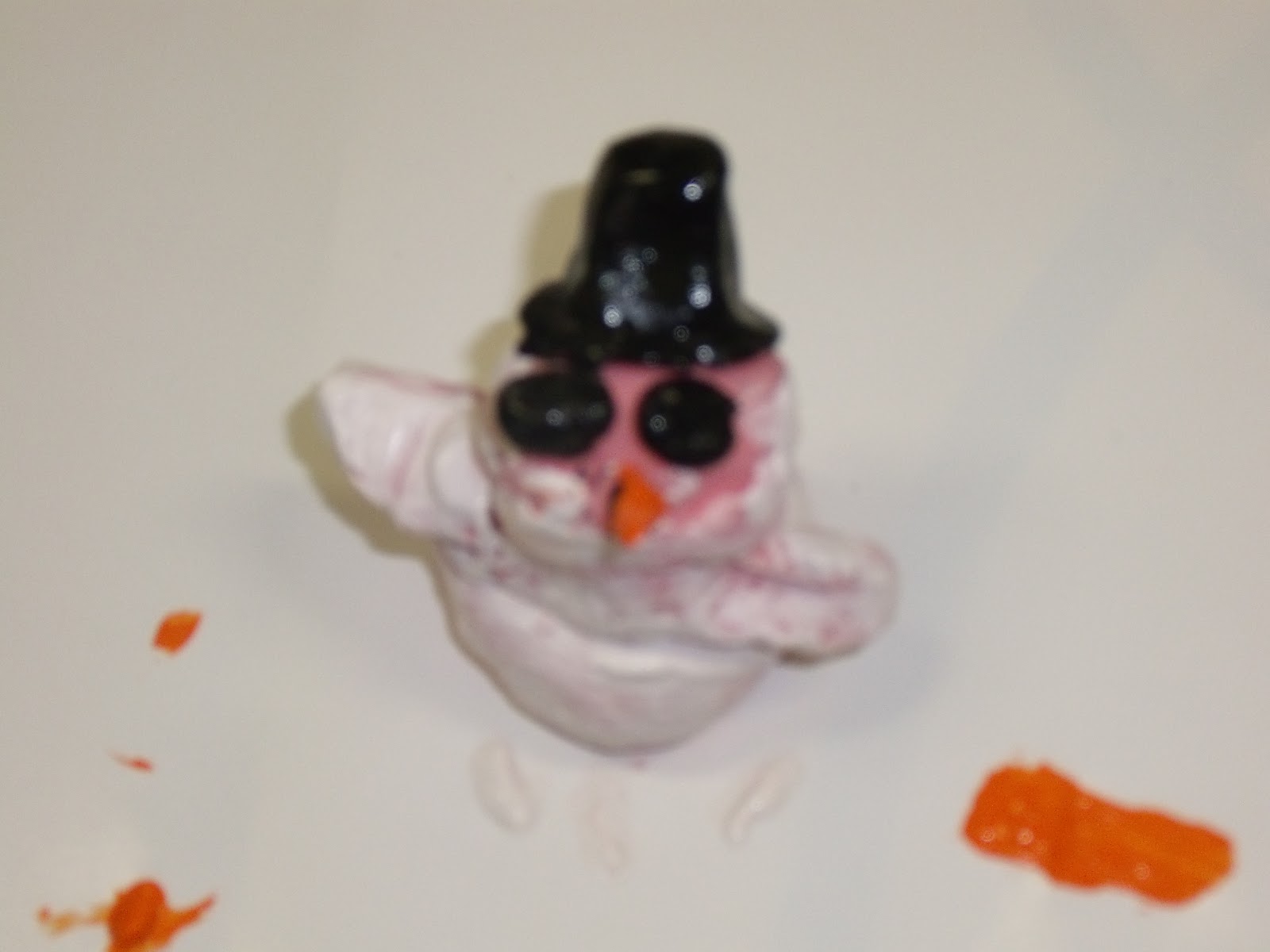
When making a snowman at the play dough table, this 4 year old boy expresses that snowmen are not pink. He verbalizes that he would like to make his snowman white. His mother asks him how he would go about doing that. He pauses to think about it and replies that he could use white paint. Together, we find some white paint and a few paint brushes. After he paints the snowman white, he realizes that the nose and top hat are not the colours he wants them to be. Again, together we collect the paint colours that he would like to apply. He notices that the carrot nose is much smaller than the snowman's body and searches for a smaller brush. The nose fell off several times, but he perservered, with his mother's help and they discovered a way to attach it. The child was very proud of his accomplishment and inspired another child to make his own snowman. He even shared his strategy for keeping the carrot nose on.The mother was pleasantly surprised with the focus and determination he used during the activity.

Learning through play at the PFLC

This is an excellent example of child led learning. The child's nanny has read Soloman Crocodile several times to her. Now, the child decides to move on  to the play dough table. She still has the story on her mind, verbalizing aloud the repeat phrase in the story. She begins to mold the play dough into characters from the book (a hippo and a crocodile). The play extends further as the child retells the story with her nanny using the play dough characters. (3.9 Retelling stories in pretend play) Notice the wide open mouth of the hippo on her left and the long body of the crocodile on her right.

Tuesday, September 25, 2012

Achievement Tree

At PQCHC we have created an achievment tree where parents, caregivers,  or parent support workers write down a positive message about a child. (i.e) started walking, knows their abc's, is sharing with his/her friends.... We are working towards filling up our tree in the next few months and discussing the childrens achievement with their parents or caregivers and give them information on how to enhance their skills through workshops or various programs with the Community Centre.


Monday, August 27, 2012

Bringing ELECT into our parent/child workshops


We know it's not enough for us, as educators, to understand how the activities and programs we plan and implement relate to ELECT. We need to continue to communicate that information to parents and caregivers. This helps establish a common language that parents will not only encounter and use here at the OEYC Ottawa South but also in early learning and care centres and finally, school.

This August, I facilitated a "Pet Rocks" workshop. Sounds cute? Though it might be "cute", that was not my goal.

Wednesday, June 27, 2012

Supporting and informing families


The second principle of ELECT states that "partnerships with families and communities strengthen the ability of early childhood settings to meet the needs of young children". It goes on to explain that "parents want to understand how their children develop and learn. They benefit from observations and information about how to support learning and recognize how their children are doing." It talks about the challenges of finding what really works when partnering with families. What works will depend on the needs of your families, their backgrounds and experiences. The framework does highlight that "the clearest effects seem to be when programming for parents and other caregivers is combined with programming for their young children."

This statement reinforces a new strategy that we are trying at the Ontario Early Years Centre Ottawa South.

We have always offered parenting workshops, information sessions during playgroup as well as parent/child early learning workshops. However, we recognized that it was sometimes difficult to fill our parenting workshops despite the requests we received from parents for information on those very topics. To overcome that challenge and ensure that we are providing that information and those resources we came up with the delivery model of offering a "hands-on" information session during our Saturday playgroup. Giving information to parents while engaging the children in play!

The first session focused on Fine Motor Skills. Pulling directly from the ELECT, we created posters highlighting the fine motor skills that can typically be observed in the different age groups along with suggestions of activities to promote the development of those skills. We added pictures and made it colourful to attract parents' attention. But we went further than simply offering the information. We added fine motor activities in all the learning centres that went along with that information and circulated to engage parents, answer questions and offer suggestions. We pointed out how the activities promoted fine motor skills and distributed handouts which included various activity suggestions to continue the learning at home.


The second session focused on sensory play. Since it wasn't a domain, we didn't pull directly from the ELECT with the skills and such. What we did do was offer a variety of sensory activities in many of the learning centers (not simply the art and sensory centre!). Children had the opportunity to finger paint, to listen to audio books, to use magnifying glasses to explore objects, touch and explore alphabet sensory pouches, among other activities. We posted words on the walls near those activities to provoke discussion with the parents. Predict, discover, explore… Create, feel, touch, smell… We once again included pictures and colour to attract their attention. We distributed handouts to encourage parents to continue the learning at home once again.


The posters and words were left up in the playgroup room in the weeks following the sessions to encourage parents to question, discuss and engage in the children's learning. The feedback we received was very positive and we look forward to offering more of these types of workshops in the fall.

Thursday, May 31, 2012

Provider ELECT Workshop at City View HCC in Ottawa


In a full day workshop for our Providers at City View Home Child Care they learned about the Early Learning for Every Child Today framework before participating in activities while connected them to E.L.E.C.T. principles, root skills and domains.  Through hands on activities and hand outs we encouraged them to embrace E.L.E.C.T. and think about the everyday things they do with the children and how it relates to E.L.E.C.T..  The Providers came up with many of their own ideas and activities and connected them to E.L.E.C.T. as well.  
Going forward, we will be handing out new additional activity sheets on a regular basis and going over them with the Providers during our home visits.  It is our intent to also hold evening sessions this fall for those who could not attend the Saturday session.  


Activities are divided amongst age groups, then one activity for each domain was done with the Providers at the Saturday workshop. Here is a sample of one activity sheet we distributed and did with them: 


Early Learning for Every Child Today
City View Centre for Child & Family Services Home Child Care
Provider Activity Sheet

AGE: 3 to 4 years of age

DOMAIN:  COMMUNICATION, LANGUAGE & LITERACY

ACTIVITY:  First Letter Boxes

Items needed:  Small boxes (shoe box size) labelled for a particular letter of the alphabet, small items that start with the letter on the box.  For example:  The letter "P": purple crayon, plastic pickle, toy pig, play dough, princess doll, toy pots and pans, toy pirate etc.

DOMAIN SKILL:  LETTER RECOGNITION (3.11)

INDICATORS OF THE SKILL:  (Look for these things children may do).  Child will identify (recognize) the letter that begins their names and it's sound.  Children will pick out other words that begin with the same letter or sound as their names.  Children will begin to identify (recognize) a few consonant letter-sound correspondences in words in familiar rhymes.
INTERACTIONS: (This is what to do and what happens when you do this activity repeatedly-over and over again).  Give the children 2 to 3 boxes at a time, using the letters that are the same as the letter that starts with their name. let them explore the contents.  Ask them questions about what is in the box, what sound does it start with, what else starts with that sound?

OBSERVATIONS: (Ask yourself) What happened when you did this activity with the children? What happened when you did this activity repeatedly (over and over again) with the children? What other activities can you think of that would help children increase their ability to recognize letters & letter sounds?

PROVIDER NOTES:  (space is provided at the bottom of each activity sheet for the Provider to add notes or ideas if they wish to).

ESL Staff discussing art with students

Parents examining art
 ELECT - Principle - Partnership with families and communities- Photo Art Project con't.- We have mounted and opened our exhibit in the offices of Graybridge Malkam. We discussed the mounting and decided to take a professional approach after looking online with the Kindergarten Children at different art exhibits and how they were curated. As well, the children recall how the exhibit they saw at the National Gallery was mounted (complete with description of the exhibit!) . They wanted it to look like "they are in the the museum".
I have attached a couple photos of our opening, unfortunately you can not see the pride on the children's faces(we did not want to publish children's faces,sorry) as they described(reflection) how they did their work to their parents. I wish I could have understood them, but of course they were all speaking in their own home languages.  Some of the families have brought their relatives in to see the work, and I have taken pictures to email to them.  One family is moving the program before the exhibit is done so they will send me a forwarding address to ship their sons work to them.  We have received rave reviews from office personnel outside of the Child Care, and visitors to the office. Clearly this has been taken very seriously by everyone with great respect given to the works of art. Apart from the obvious benefits to the children, this project is further building community for our families, creating opportunities for dialogue about ELECT and shining a positive light on the importance of "child's work".  It is making adults think! 

Tuesday, May 29, 2012

Home Child Care Ambassadors

Home Child Care Ambassadors are meeting monthly to: network; develop learning tools for providers; share ideas about tools that agencies are developing. In terms of tools, we are creating cards that explain each Principle in depth that will incorporate a rationale and examples/activities.

Tuesday, May 01, 2012

Baking Soda experiences

From our baking soda and vinegar experiences, we began capturing details of our volcano eruptions and have started observation journals of our findings with the children.
Our book is displayed on our parent board and a copy on our children's book shelf.

Monday, September 26, 2011

Un peu de colle, des cartons d'oeufs et plein d'imagination... Voilà nos créations!

J'ai plusieurs parents qui m'apportent du matériel recyclable pour les arts tel que des cartons d'oeufs, des boîtes vides de mouchoirs, etc. J'ai voulu utilisé ces matériaux donc, j'ai préparé ma programmation pour la table d'arts et j'ai placé le matériel sur la table.

Certains enfants ont créé des chenilles pour ajouter à notre muraille et d'autres enfants ont tout simplement coupé, collé et dessiné. Mais chaque enfant s'est amusé tout en apprenant à utiliser divers outils de fine motricité (ciseaux, colle, crayons feutre).

DISCLAIMER/ AVIS DE NON-RESPONSABILITÉ:

By using this site, you confirm that you have read and understand the policies and that you will respect the policies at all times.
Lorsque vous utilisez ce site, vous confirmez avoir lu et compris les politiques et que vous respectez les politiques en tout temps.